
Rear Filling vs. Front Filling for 2-Component Cartridges
Posted
Rear Filling vs. Front Filling for 2-Component Cartridges
When it comes to semi-automatic filling of 2-component cartridges, there are two commonly used methods: rear filling and front filling. Each approach has its own advantages, limitations, and best-use cases.
What’s the Difference?
Rear Filling
With rear filling, the cartridge is filled through the large rear opening. Once filled, the pistons are inserted to seal the materials inside the cartridge.
Front Filling
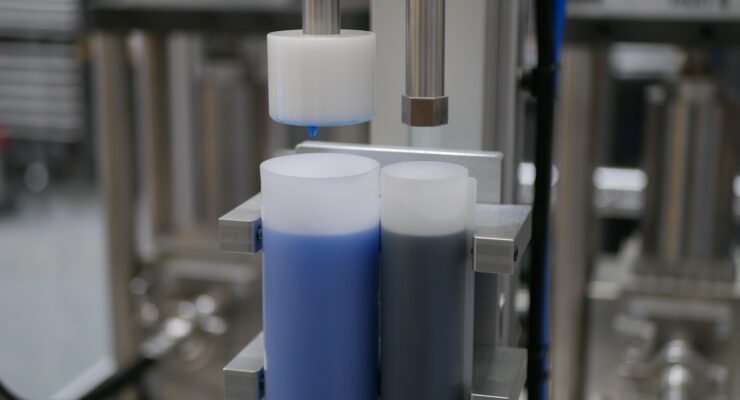
Front filling works in the opposite order. The pistons are first inserted and pushed fully into the cartridge. The outlet plug is then removed, the material is filled through the cartridge outlets, and the plug is reinserted to seal the cartridge.
Cartridge Type Considerations
Not all cartridges are suitable for both filling methods.
- Cartridges that require front-filling
Some cartridge designs, such as the Nordson U-TAH and Medmix ecopaCC, can only be filled using the front filling method. - Cartridges compatible with both methods
Most conventional side-by-side cartridges can be filled using either rear or front filling. - Cartridges that require rear-filling
Cartridges that feature a snap-off cap or a coaxial outlet, require rear-filling.
Viscosity Considerations
Material viscosity plays a major role in determining the most suitable filling method.
Front filling requires the filling nozzle to fit inside the cartridge outlet. This limits the nozzle bore size and restricts material flow. For higher viscosities, back pressure from the small bore, results in:
- Reduced flow
- Slower filling speeds
To compensate, higher fluid pressure can be applied, however this may demand a more powerful pump or dosing system, which in turn can put unwanted stress on the cartridge.
Rear filling does not have this restriction. A larger-bore filling mandrel can be used, allowing:
- Higher flow rates
- Lower filling pressures
- Faster filling cycles, particularly with high-viscosity materials
Quality Considerations
Regardless of the filling method, the goal is the same:
- Void-free filling
- Even fill levels
- Consistent piston positions for both components
Rear filling quality depends on:
- Correct fit of the filling mandrel
- Proper cartridge support during filling
- Synchronisation between dosing output and cartridge retraction (in automated systems)
Front filling quality depends on:
- Pistons being fully and correctly inserted
- Good sealing between the filling nozzles and cartridge outlets
- Adequate support applied to the pistons during filling
Additional Cartridge Considerations for Front Filling
Front filling can introduce extra demands on the cartridge itself in the following areas:
- Pre-insertion of pistons – if the pistons are fully inserted into the cartridge too long a time in advance of the cartridge being filled, there is a risk the piston will deform to the smaller diameter at the top of the cartridge which can compromise their sealing ability when returned to the bottom of the cartridge after the filling process.
- Cap to outlet sealing – care should be taken to make sure tight-fitting filling nozzles don’t permanently enlarge the cartridge outlet – reducing the sealing effectiveness between cap and outlet.
- Managing stress on the cartridge – when cartridges are crimped before filling, care should be taken to insure the cartridges are not over filled,
Efficiency and Filling Speed
Both methods require a piston insertion step:
- Rear filling: pistons inserted after filling
- Front filling: pistons inserted before filling
Front filling also includes extra steps:
- Removing the outlet cap before filling
- Replacing the cap after filling
Filling speed is largely influenced by material viscosity and dosing equipment capability. However, rear filling generally allows for more unrestricted material flow—particularly with high-viscosity products—making higher throughput easier to achieve (depending on machine specifications).
Conclusion
With the exception of cartridges that must be front-filled, we (at Grunfeld) generally recommend rear filling.
In some circumstances, the front filling method can offer comparable filling speeds and a lower initial outlay in terms of machine purchase, i.e. for filling operations that only fill lower viscosity materials.
However, for higher-viscosity materials, rear filling is strongly recommended. Its unrestricted flow enables faster filling speeds and lower operating pressures, resulting in a more efficient and robust filling process.
If you have a question around the topic of rear vs’ front filling or any other cartridge filling quires, please don’t hesitate to reach out to us.