
Multi-reference Filling Machines
Posted
Multi-reference Filling Machines
Multi-reference filling machines are a great way to improve the filling process across multiple products and packaging types.
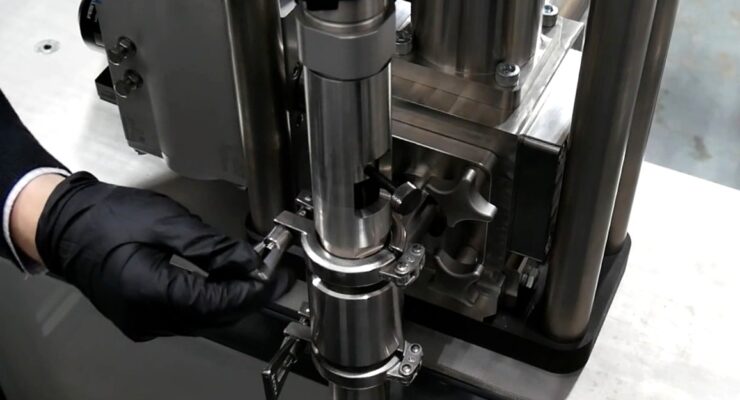
However, they do require a certain amount of change tooling to handle a range of packaging formats. To be effective as a multi-reference machine, the changeovers need to be quick and easy.
A successful multi-reference machine must therefore be designed to be quick and easy to set up, while remaining robust and reliable in operation.
The Case for a Multi-reference Machine
The demand for specialised adhesives continues to grow because end users increasingly want more from their adhesive products. They want:
- The ability to bond a wider range of materials
- Different curing speeds to suit their application
- Improved performance characteristics
- Cartridge sizes that better match their usage requirements
As a result, formulators’ R&D teams are constantly developing new products. Over time, this leads to an increasing number of product variants and, in many cases, a wider range of cartridge types that need to be filled.
This is where a multi-reference filling machine can provide significant value.
Multi-reference Machine Configurations
There are several approaches to designing a multi-reference filling machine.
1. Interchangeable Parts and Stations
One approach is to use interchangeable parts and stations, allowing the machine to be reconfigured quickly between different packaging formats.
Typical features include:
- Adjustable guides on infeed tracks
- Vision systems for good/bad orientation checks
- Recipe-based settings that can be selected via the touchscreen
- Location dowels for repeatable positioning of change parts
- Single multi-pin plugs for connecting interchangeable stations.
The aim is to minimise setup time while ensuring repeatability and reliability after every changeover.
2. Dedicated Stations
Another approach is to incorporate dedicated stations that are only used when a particular packaging type is being processed.
Dedicated stations are most commonly used where there is a substantial difference between references, to the extent that both formats would be compromised by trying to share the same resource. They can also make sense when the required change tooling would become too costly or set-up too time-consuming.
In most cases, dedicated stations result in a higher machine cost, but they can provide a more practical solution for significantly different packaging formats.
3. Interchangeable Parts/Stations and Dedicated Stations
Depending on the range of cartridge sizes and packaging types, a combination of interchangeable parts and dedicated stations may provide the best solution.
The right balance will depend on the mix of packaging types, production volumes, and future requirements.
Key Considerations
When assessing a multi-reference filling machine, several factors should be considered:
a. What is the mix of packaging sizes?
The range of packaging sizes will influence the type and extent of change tooling required, and therefore the expected changeover times.
In some cases, the variation between sizes may justify a configuration with some dedicated stations.
b. Are additional cartridge sizes likely in the future?
It is worth considering whether future product developments may require new packaging formats.
Where possible, provisions can be incorporated into the machine design to simplify future additions.
c. Where is the greatest demand?
It makes sense to optimise the machine around the packaging format with the highest demand, ensuring maximum efficiency where it will have the greatest impact.
d. What are the typical batch sizes?
Batch size will influence how often changeovers are required.
Understanding run lengths helps quantify the impact of setup time.
e. What makes technical sense?
Some product and packaging combinations present challenges.
If a low-demand packaging format requires extensive change tooling, it may be more practical to leave that format outside the project scope rather than introduce unnecessary complexity.
f. Cost
The more references a machine is required to handle, the greater the cost is likely to be.
Decisions such as change tooling versus dedicated stations can have a significant impact on the overall investment.
g. Complexity
While we are dedicated to making change parts quick, easy, and robust, every changeover introduces another step into the production process.
Reducing complexity wherever possible helps improve efficiency.
h. Operator Training
One consideration that should not be overlooked is the skill level required to perform changeovers.
Can the setup be completed by machine operators, or is engineering support required?
If changeovers are considered an engineering task, the availability of engineering resources can directly impact production efficiency.
For this reason, we focus on making as many changeover processes as possible toolless, or requiring only minimal tools. We also incorporate design features that prevent incorrect reassembly, helping to make changeovers faster, simpler, and error-proof.
Conclusion
It all starts with understanding the mix of packaging types: identifying what is similar, what is significantly different, and what makes sense from both a technical and commercial perspective.
From there, the considerations outlined above help determine the right balance between interchangeable tooling, dedicated stations, cost, and flexibility.
And we’re here to help.