
Void-Free Filling and Correct Piston Insertion
Posted
Void-Free Filling and Correct Piston Insertion
For many adhesive and sealant applications, ensuring void-free material within the cartridge is critical.
In single-component sealant applications, an air bubble can create a void in the bead, requiring retooling.
In two-component adhesive applications, an air bubble may cause a ratio imbalance, leading to soft spots in the bond.
In high-performance industries – where the price of failure is significant – some standards dictate that if an air bubble is detected in a bead of adhesive, the remaining material in the cartridge must be discarded. Additionally, any applied adhesive must be removed and re-applied.
Needless to say, air bubbles or voids within a cartridge are, at best, an inconvenience, and at worst, a serious risk that can compromise the performance and durability of an assembly.
Starting with the Bulk Material
Achieving a void-free product begins well before the cartridge filling stage. It starts with the mixing and compounding of the bulk material.
Bulk material should always be mixed under vacuum, using a vacuum mixer, to minimise the introduction of air.
In some operations, the material is fed directly from the mixing vessel to the filling line. However, there is often an intermediate “down-packing” stage, where material is transferred into drums or pails.
During this transfer, care must be taken to avoid introducing air pockets or voids—particularly with high-viscosity materials that do not flow easily. In such cases, a drum filling station can help ensure void-free filling of drums or pails.
Feeding the Filling Line
When feeding bulk material to the filling line – especially when using a press or follower-plate-mounted pump – it is essential to eliminate any trapped air.
The “headspace” (the air pocket at the top of the vessel, drum, or pail) must be fully evacuated. For presses or pumps with captive seals on the platen, this is typically achieved via a bleed valve.
It is also crucial to purge any air from the transfer lines and metering units before filling begins.
The Filling Process
Manual Filling
Manual filling operations typically rely on a well-fitting mandrel and a skilled operator. The operator must consistently apply the correct amount of back pressure as the material flows into the cartridge.
Once dosing is complete, and depending on the material viscosity, it may be advisable to leave the material in a peak. However, this depends on both the material and the piston type being used. Grunfeld or the cartridge manufacturers can provide guidance on this.
Automated Filling
Grunfeld automated filling machines synchronise the output of the dosing unit with the travel speed of the cartridge to ensure consistent, void-free filling.
Recipes for different material grades (formulations) and cartridge types are programmed and saved via a touchscreen interface, ensuring repeatability and process control.
Piston Insertion
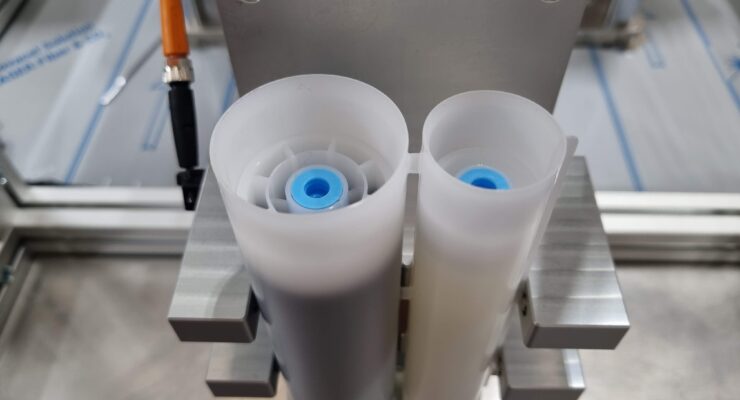
The final step in achieving a void-free cartridge is correct piston insertion.
Following the appropriate insertion and closure procedure for the specific piston type ensures that any remaining air is evacuated and that a liquid-tight seal is formed.
Inspection and Validation
Automated inspection and quality control systems can be optioned on Grunfeld filling machines to detect and isolate defective cartridges.
These systems provide an additional layer of assurance, helping to maintain product quality and consistency.
Storage and Transport Considerations
Even after filling, care must be taken to prevent air from being reintroduced during storage or transport.
Air freight, in particular, can pose challenges due to pressure changes at different altitudes, which may affect the cartridge.
To mitigate this, crimping – creating indentations in the cartridge wall below the piston – may be used to secure the piston in place. This prevents movement caused by material expansion or contraction.
In some cases, cartridges may also be vacuum-sealed in laminate bags for additional protection.
While these measures are not always necessary, they should be considered when cartridges are likely to experience unstable storage or transport conditions.
Summary
Achieving void-free cartridges requires attention at every stage of the process:
- Begin with proper vacuum mixing.
- Take care during down-packing into drums or pails.
- Fully evacuate headspace in vessels, drum or pail.
- Purge air from all lines and metering systems.
- Ensure void-free filling
- With well fitting mandrels for manual filling,
- Or automatic synchronisation on Automated Grunfeld systems.
- Insert and seal pistons correctly.
- Implement inspection and quality control where possible.
- Consider storage and transport conditions.